


- By Inessa Peters
- November 3, 2026
- No Comments
Traditional vs. Apex Track
Traditional vs. Apex Track in Empower: Which Integration Algorithm Should You Choose?
Do you know the difference between the Traditional and Apex Track integration algorithms in Empower CDS?
Both algorithms are used to identify and integrate chromatographic peaks, but they approach peak detection differently. Understanding how they work can help you choose the right algorithm for your chromatograms and develop more reliable Processing Methods.
In this article, we’ll look at how each algorithm works, compare their capabilities, and discuss which one to choose for your analytical methods.
1. How Do Integration Algorithms Work?
Integration algorithms define how Empower identifies chromatographic peaks, determines their maxima, and positions the peak start and end points.
When we look at a chromatogram, we can usually recognize where a peak starts, where its maximum is, and where it ends.
But Empower doesn’t have eyes. It needs instructions to determine these points. This is exactly what the integration algorithm does.
Empower offers two integration algorithms to choose from – Traditional and Apex Track.
Let’s look at how they work.
2. Traditional Integration Algorithm
The Traditional Algorithm uses the first derivative of the chromatogram, which describes the slope of the signal.
By evaluating changes in the slope, Empower identifies the characteristic points of a chromatographic peak:
Peak start: The signal begins to rise from the baseline.
Peak maximum: The slope changes from positive to negative.
Peak end: The signal returns to the baseline.
This approach works well for conventional peak shapes, such as normal and valley peaks.
However, it has limitations when dealing with more complex peak shapes.
3. Apex Track Integration Algorithm
Apex Track is a more advanced integration algorithm that uses the second derivative of the chromatogram.
Based on the second derivative, Empower first identifies the peak maximum and then determines the peak start and end positions.
This different approach offers several advantages, particularly when working with more challenging chromatograms.
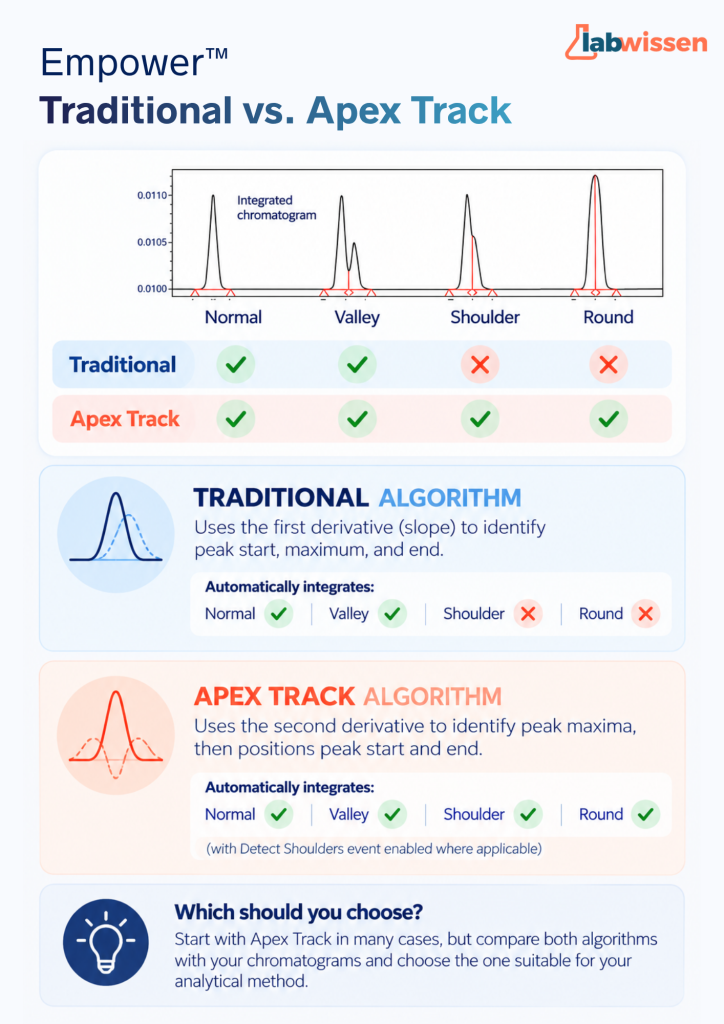
Apex Track supports automatic detection of additional peak shapes, including shoulders and round peaks, when the appropriate integration settings are enabled.
It also provides additional integration parameters, giving analysts more flexibility when optimizing peak integration.
4. Traditional vs. Apex Track: What Are the Differences?
So, what does the choice of integration algorithm actually mean for your chromatograms?
The main differences become visible when working with more complex peak shapes, sloping baselines, and integration settings.
Let’s look at three situations where Apex Track offers additional capabilities.
1. Integration of Different Peak Shapes
The Traditional Algorithm automatically integrates normal and valley peaks.
Apex Track offers additional capabilities: it can also automatically detect shoulder and round peaks, with Detect Shoulders event enabled.
This makes Apex Track more flexible when working with chromatograms containing different peak shapes.
2. Integration with Sloping Baselines
Apex Track can handle sloping baselines and small peaks appearing on them more effectively in many cases.
With the Traditional Algorithm, changes in the baseline slope can influence peak detection because the algorithm evaluates the first derivative (= the slope) of the signal.
Apex Track uses the second derivative, which makes its peak detection less dependent on the overall baseline slope.
As a result, it can be particularly useful when integrating small peaks on a sloping baseline.
3. Integration Parameters and Flexibility
Apex Track provides additional integration parameters compared to the Traditional Algorithm.
These parameters give you more flexibility to adjust how Empower detects and integrates peaks.
This is especially useful when working with challenging chromatograms where the default integration settings do not produce the desired results.
You have more options to fine-tune the integration and achieve consistent results.
Comparison at a Glance
The following infographic summarizes the main differences between Traditional and Apex Track:
5. Which Integration Algorithm Should You Choose?
In most cases, I recommend starting with Apex Track.
It offers more flexibility, supports additional peak shapes, and can be particularly useful when working with sloping baselines.
However, there is no universal answer.
Every chromatogram is different. The most suitable algorithm depends on your analytical method, peak characteristics, and integration requirements.
My recommendation:
Try both algorithms with your actual chromatograms.
Compare how they integrate different peak shapes.
Pay particular attention to peak start, maximum, and end positions.
Check whether the integration is consistent across your samples.
Choose the algorithm that provides appropriate and reproducible integration for your analytical method.
Remember that choosing an algorithm is only the first step. The integration parameters must also be configured correctly.
Want to Learn More About Processing Methods?
Understanding how integration algorithms work is just one part of developing a good Processing Method.
If you want to learn how to configure integration parameters and fine-tune your Processing Methods, here are more articles you might find useful:
- Peak Width
- How to set Peak Width by Tradtional Algorithm
- Threshold
- How to set Threshold by Traditional Algorithm
- How to set Integration Parameters by Apex Track
- Liftoff and Touchdown – Apex Track
- Skims
- Typical Errors Duirng Data Processing
Need help with Empower?
Have a technical question, a workflow challenge, or looking for a more efficient way to work?
Let’s discuss it! I’m happy to share my experience and help you find a practical solution.